By Misi Stine, Environmental Educator and member of the MN Herpetological Society

As a child growing up in the 1970’s, I would be excited for the night to come at the family cabin north of Aitkin, because that is when the beautiful and magical blinking lights of the fireflies would light up the sky. I would chase them around the yard, with my cousins and hope to catch one, and hold it briefly in a glass jar to observe it before watching it fly away into the night. These are among some of the most magical memories of my childhood in the woods.
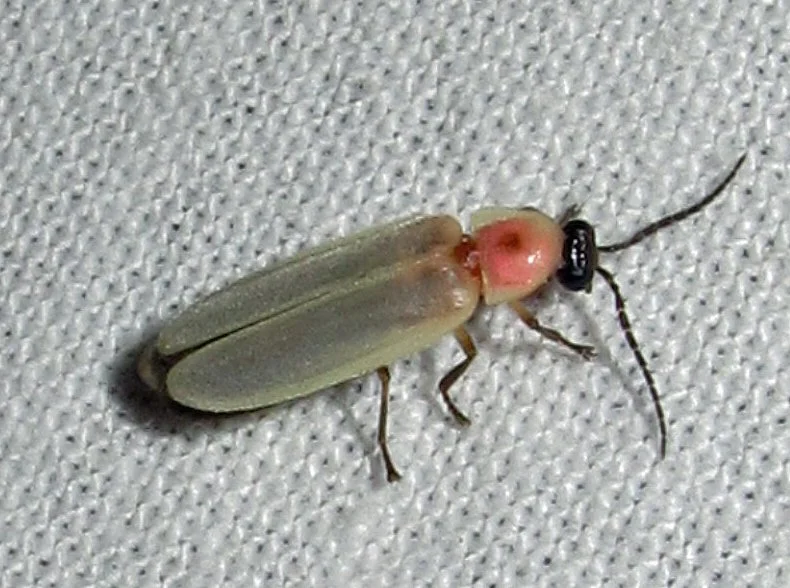
Photinus marginellus
Minnesota is home to various species of fireflies, the Photinus and Photuris species are the most common in North America. Fireflies are beetles, their life cycle has four stages. The eggs are laid in moist soil, after about three weeks they hatch into larva, spending 1-2 years in the soil consuming snails and slugs. Next they transition into the pupa stage which is a state of dormancy (typically in fall and winter), and then finally they emerge into the adult stage, which is when most species are able to display their flashing light, although some species will glow during the egg and larva stage as well. The adult stage lasts about three weeks before they mate, lay their eggs, and die.
Each species has their own distinct flashing pattern, which is primarily used to attract mates, to defend their territories and to warn predators. Males and females both glow but in most species the males fly around while the females hang out in the shrubs, grass, and trees as the look for love. If you observe them long enough you can learn to identify the species based on those flash patterns.
The flash is created through a natural process called bioluminescence. Unlike a light bulb that gets hot when it glows, a firefly's light is a "cold light," meaning little energy is lost as heat. Making it incredibly efficient for them.
The process occurs in specialized cells, usually in the lower part of their abdomen. There are two key ingredients that come together: a chemical called luciferin, and an enzyme named luciferase. Think of luciferase as the spark plug in a car or lawnmower that makes the chemical reaction go.
When a firefly breathes in oxygen it combines the three chemicals: luciferin, luciferase, and oxygen, along with another energy-carrying molecule called ATP, which results in the creation of light. The firefly can control the flow of oxygen to these cells, turning its light on and off like a tiny switch, creating the distinct flash patterns we see.
Different firefly species have slightly different versions of luciferin and luciferase, which is why their lights can vary in color, from yellow to green to orange.
As an adult, I have rarely seen fireflies in any substantial numbers because, today, firefly populations are declining due to several factors. Minnesotans can have an opportunity to have a positive impact on their populations. Below I will outline the four issues and how you can help.
As I have stated in many articles, one of the biggest threats to wildlife species across the world is habitat loss, and fireflies are no exception.
Fireflies are most at home in habitats with tall grass, leaf litter, and access to moisture, such as the edges of woodlands, meadows, and wetlands. If there are areas on your land where grass can grow taller, let fallen leaves and rotten logs remain undisturbed that will help by providing shelter and hunting grounds for larval fireflies.
The Minnesota DNR suggests protecting and restoring wetlands, ponds, streams, rivers, and small depressions that fill fireflies and many other wildlife species habitat.
Widespread use of insecticides is harmful to both adult and larval stage fireflies. Where you can limit or eliminate the use of pesticides on your property please do, especially broad-spectrum insecticides which can kill the fireflies and their food source. Suggestions found in the resources for this article suggest using more organic pest control methods and embracing co-existence insect neighbors, as they are part of a healthy ecosystem.
Light pollution disrupts their communication, reducing the chance of them mating and successfully reproducing. Consider turning off outdoor lights at night, using motion-activated lights, and downward facing, shielded lights with warmer hues. In addition, draw your curtains, and allow for true darkness.
Scientists need more information on the distribution and abundance of fireflies. You can participate in community science efforts by reporting your firefly sightings. Please go to this link to find more information on how to contribute your sightings: www.firefly.org/firefly-sightings
It is nice to know that there are practical things you can do to help conserve fireflies and ensure that future generations will have an opportunity to observe and enjoy these critters on those beautiful Minnesota summer nights. I know I am a more nature curious and passionate person about my outdoor pursuits because of childhood experiences like these.

Bibliography
Firefly Natural History:
firefly.org. "Firefly Facts." Accessed [Current Date, e.g., October 26, 2023]. https://www.firefly.org/firefly-facts
Conservation Status & Landowner Actions:
Xerces Society. "Conservation Status of Fireflies in the U.S. & Canada." Accessed [Current Date, e.g., October 26, 2023]. https://www.xerces.org/publications/conservation-status-reviews/conservation-status-fireflies-us-canada
Xerces Society. "Reducing Light Pollution to Help Fireflies and Other Nocturnal Insects." Blog post. Accessed [Current Date, e.g., October 26, 2023]. https://www.xerces.org/blog/reducing-light-pollution-to-help-fireflies-and-other-nocturnal-insects
Xerces Society. "Firefly Conservation Fact Sheet." Accessed [Current Date, e.g., October 26, 2023]. https://www.xerces.org/publications/fact-sheets/firefly-conservation
firefly.org. "What You Can Do." Accessed [Current Date, e.g., October 26, 2023]. https://www.firefly.org/what-you-can-do
Minnesota-Specific Habitat/General Information:
Minnesota Department of Natural Resources (MNDNR). "Native Plant Gardens." Accessed [Current Date, e.g., October 26, 2023]. https://www.dnr.state.mn.us/gardens/nativeplants/index.html
Minnesota Department of Natural Resources (MNDNR). "Wetlands in Minnesota." Accessed [Current Date, e.g., October 26, 2023]. https://www.dnr.state.mn.us/wetlands/index.html
General Species Information/Citizen Science:
Xerces Society. "Endangered Species: Fireflies." Accessed [Current Date, e.g., October 26, 2023]. https://www.xerces.org/endangered-species/fireflies
Firefly Atlas. https://www.fireflyatlas.org/ (Data accessed for general understanding of species distribution efforts).