By Misi Stine, Environmental Educator and member of the MN Herpetological Society
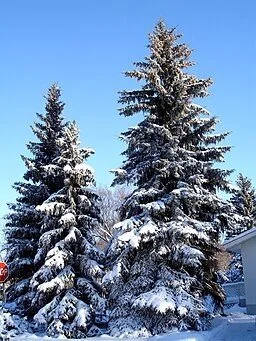
daryl_mitchell from Saskatoon, Saskatchewan, Canada, CC BY-SA 2.0 <https://creativecommons.org/licenses/by-sa/2.0>, via Wikimedia Commons
With the holiday season upon us and the widespread use of evergreens in our celebrations, it’s the perfect time to explore how our local wildlife uses this vital winter resource. The tradition of honoring evergreens is an ancient one; Pagans used them as a potent symbol of life during their winter solstice celebrations. As Christianity grew, church leaders often incorporated these Pagan traditions to create a connection for those newly adopting the faith. More modern Christmas tree customs, of course, were thoughtfully developed in Germany by the 16th century.
During long Minnesota winters, dependable habitat becomes scarce as the deciduous trees drop their leaves and enter dormancy. The resilient coniferous trees—our pines, spruces, and cedars—shoulder the crucial burden of providing food and shelter for many wildlife species, faithfully retaining their needles through the long, snowy months.
The dense needles create a protective microclimate that welcomes relief from the cold. Conifer species dramatically reduces wind, minimizes snow accumulation beneath the boughs, and offers higher ambient temperatures compared to open areas of the forest. Animals like White-tailed Deer and Snowshoe Hares rely heavily on stands of conifers, particularly Northern White Cedar and Balsam Fir, for this crucial thermal cover. This protective covering allows them to conserve precious energy, which can ultimately mean the difference between life and death before spring arrives. Additionally, many species of overwintering birds, both large and small, use the dense conifers for essential protection from the harsh elements and potential predators.
Conifer cones are hiding and protecting calorie-dense seeds that provide crucial food throughout the winter. The hardworking Red Squirrel and Chipmunk spend the autumn collecting cones and caching them for later use. They then spend the winter stripping away the outer cone layers to enjoy the seeds within. Specialized birds, such as the Red Crossbill and Pine Siskin, have beaks uniquely adapted to pry open the scales and efficiently consume the seeds.
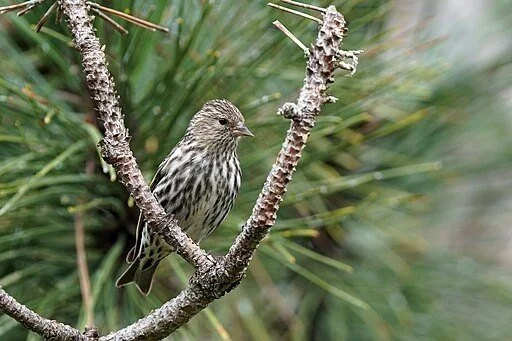
Pine Siskin
U.S. Fish and Wildlife Service - Midwest Region, Public domain, via Wikimedia Commons
Even the waxy needles themselves serve as sustenance. The Spruce Grouse enjoys the needles of spruce and jack pine, while the White-tailed Deer browses on the needles of White Cedar and Balsam Fir. Although these needles aren't as nutrient-rich as summer forage, they can be a critical food source when deep snow makes other options inaccessible. Furthermore, the Porcupine strips the bark and cambium for a meal—a habit that, while natural, can sometimes lead to human displeasure!
The great value of conifers extends to the smallest creatures. These trees secretly hide overwintering insects and their eggs within their bark and crevices. Small, energetic birds like the Red-breasted Nuthatch and the Black-capped Chickadee actively search the branches and trunks for this hidden, high-protein meal, ensuring their continued survival through insect scarcity.
Minnesota's evergreen trees are truly an enduring symbol of the holiday season for us, and an absolutely vital lifeline for our local wildlife. Knowing this deep connection to survival makes me even more appreciative of this precious natural resource and of the dedicated landowners who ensure these majestic trees will remain part of Minnesota’s natural landscape for years to come.
Happy Holidays to you and your family!
Bibliography
Minnesota Department of Natural Resources. Conifers: Young Naturalists Article.
Audubon Society. Level Up Your Winter Birding By Knowing Your Conifers.
The Nature Conservancy. What's Happening in Nature this Season in Minnesota.
University of Minnesota Extension. Manage woodlands for wildlife.
History.com https://www.history.com/articles/history-of-christmas-trees