By Misi Stine, Environmental Educator and member of the MN Herpetological Society
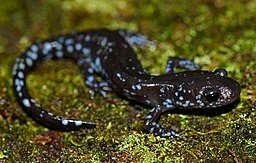
Blue Spotted Salamander
Peter Paplanus, CC BY 2.0 <https://creativecommons.org/licenses/by/2.0>, via Wikimedia Commons
Salamanders are one of two types of amphibians found in Minnesota; frogs and toads are the other. Salamanders are a group of vertebrates that live both in water and on land at different life stages and are ectotherms, or “cold-blooded”. Unlike frogs and toads, most salamanders retain their tails throughout their lives. When you think of a slimy animal, amphibians fit the bill, with their smooth, moist skin giving them a slippery sort of feel, especially when wet. Their skin is crucial for respiration, allowing them to absorb oxygen directly from their surroundings, including dissolved oxygen in water.
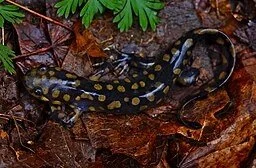
Eastern Tiger Salamander
Peter Paplanus, CC BY 2.0 <https://creativecommons.org/licenses/by/2.0>, via Wikimedia Commons
Globally, there are over 700 known species of salamanders, and Minnesota is home to a handful of species. They act as environmental indicators because of their semipermeable skin, which can absorb not only oxygen but water and other substances, making them sensitive to toxins, pollutants, and chemical residues.
The life cycle of a salamander is a fascinating process. For most species, it begins in water, where eggs are laid that attach to submerged vegetation. The eggs hatch into aquatic larvae, with external gills for breathing underwater. As they grow, the larvae undergo metamorphosis, losing their gills and developing lungs and legs, preparing them to leave the water and continue their life cycle as a terrestrial animal. Once mature, adult salamanders may spend much of their time on land, only returning to water to breed. However, there are a few exceptions, such as the mudpuppy, which is entirely aquatic and lives its entire life in lakes and rivers.
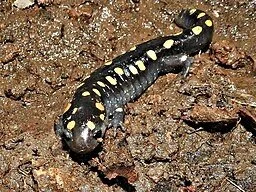
Spotted Salamander
USFWSmidwest, Public domain, via Wikimedia Commons
Minnesota has a variety of species, each with its preferred habitat. The blue-spotted salamander is common in forested areas, particularly near temporary wetlands and vernal pools. These small, dark salamanders are easily recognized by their distinctive blue flecks. The eastern tiger salamander, one of the largest terrestrial salamanders in North America, favors open grasslands, woodlands, and agricultural fields and often uses deep burrows. Its striking yellow spots on a dark background make it quite distinctive. The spotted salamander is another forest dweller, often found near ponds and swamps, known for its bright yellow or orange spots. The primary way to identify the spotted salamander is that its spots are in rows, whereas the tiger salamander's spots are randomly distributed across their body.
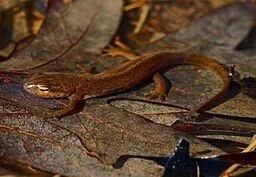
Eastern Newt
Peter Paplanus, CC BY 2.0 <https://creativecommons.org/licenses/by/2.0>, via Wikimedia Commons
The eastern newt is unique among Minnesota's salamanders and other amphibians because of its complex lifecycle. After its aquatic larval stage, it metamorphoses into a terrestrial juvenile known as a red eft. These efts are bright orange or reddish-brown, with granular skin, and can live in the forest for several years before returning to an aquatic life as an adult, which is more olive green. It is best to look, not touch, when you encounter a newt because of the potent neurotoxin tetrodotoxin (TTX) on their skin, the same toxin found in pufferfish. If the poison is ingested, it can be fatal to predators and humans, although garter snakes have adapted to successfully consume them. If you touch a newt, wash your hands well with soap and water.
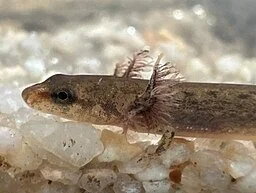
Mudpuppy
MallardTV, CC0, via Wikimedia Commons
As mentioned earlier, the mudpuppy is a fully aquatic species inhabiting the bottom of larger lakes and rivers, recognizable by its bushy red external gills. The less common four-toed salamander prefers sphagnum bogs, while the red-backed salamander is a strictly terrestrial species that lives under logs and leaf litter, and instead of laying their eggs in water, they lay their eggs in moist, hidden locations, such as decomposing woody materials (logs and stumps), and underneath rocks.
Salamanders have an incredible regenerative ability, which is under scientific investigation to better understand these amazing adaptations, with the hope that understanding this physiological process will benefit humans. Many species can regrow lost limbs, tails, and even portions of their hearts and brains. Salamanders prey on a wide variety of insects, making them a natural pest-control agent. They are also prey for a variety of animals, including snakes, birds, and small mammals.
When considering land management practices that support salamanders, here are some things to consider:
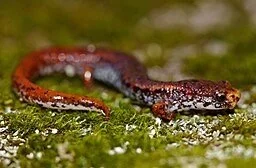
Four-Toed Salamander
Peter Paplanus, CC BY 2.0 <https://creativecommons.org/licenses/by/2.0>, via Wikimedia Commons
● Protect and Restore Wetlands: They are critical for reproduction and support amphibians’ survival overall. Another key feature of bodies of water that support salamanders is that they are fishless, as fish predation can limit or eliminate salamander populations.
● Minimize Chemicals: Where possible, limit or eliminate the use of chemicals. As mentioned earlier, their semipermeable skin is sensitive to environmental chemicals.
● Create Shelter: brush piles, stacks of logs, and rocks create shelter and provide moisture needed for maintaining health.
● Keep Leaf Litter: Thick layers of leaves on the forest floor provide critical habitat and protect salamanders from drying out. If their skin dries out, it will kill them.
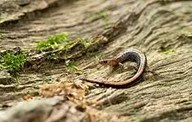
Red-Backed Salamander
ShenandoahNPS, Public domain, via Wikimedia Commons
● Manage Invasive Species: Invasive plants can degrade habitat; remove invasive plants with a minimal amount of soil disturbance.
● Avoid Compaction: Salamanders need loose soil they can burrow into, using equipment that compacts soil impacts survival because they cannot burrow when needed. Heavy equipment can cause underground burrows to collapse.
Works Cited
● Conant, R., & Collins, J. T. (1998). A Field Guide to Reptiles & Amphibians: Eastern and Central North America. Houghton Mifflin Harcourt.
● Lannoo, M. J. (Ed.). (2005). Amphibian Declines: The Conservation Status of United States Species. University of California Press.
● Minnesota Department of Natural Resources. (2023). "Minnesota Profile: Eastern Newt (Notophthalmus viridescens)." Minnesota Conservation Volunteer.
● Moriarty, J. J., & Hall, C. D. (2014). Amphibians and Reptiles in Minnesota. University of Minnesota Press.
● Petranka, J. W. (1998). Salamanders of the United States and Canada. Smithsonian Institution Press.