By Emily Haeg, MNDNR Central Region Information Officer.
Article originally featured in MNDNR’s internal staff newsletter as employee profile.
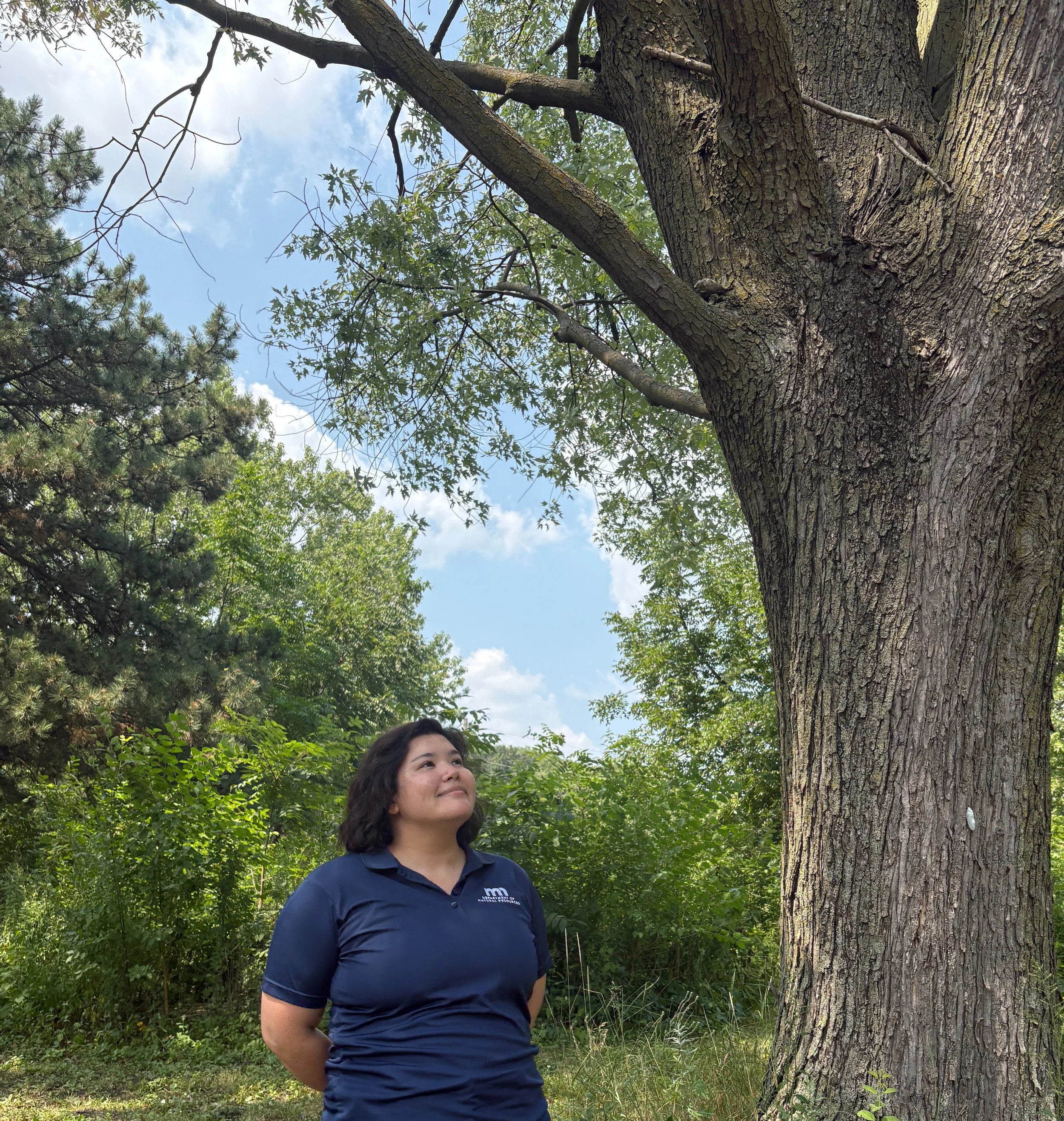
The Silver Maple tree (Acer saccharinum) can be a divisive topic for arborists and casual tree admirers alike. This native deciduous species is often criticized for growing too aggressively in urban areas and refusing to fit neatly into the spaces around it.
In DNR Forester Hannah Milos, the Silver Maple has one branch of steadfast support.
“It’s an unpopular opinion, especially for a forester, but they really are one of my favorites,” shares Milos. “They provide excellent shade, a habitat for wildlife, and hold a special place in my heart.”
Ask Milos where her love of Silver Maples began, and she'll take you back to the front yard of her childhood home in South St. Paul.
"We had this big silver maple tree that my dad planted right when my parents bought our house,” she shares.
While the silver maple gave her a place to climb, Milos says was still searching for a place to belong. Growing up in a multiracial household, she says she sometimes felt like she didn't quite fit in.
"My dad is white from the Midwest and my mom is from Hawaii and ethnically Japanese," she says. "As a kid, not fitting neatly into one group or category can leave you feeling like a bit of an outsider."
The outdoors became a place where those feelings seemed to quiet. Some of her happiest memories are shaped by family hikes, camping trips, and hanging out with her favorite silver maple.
“I loved climbing that tree and just spending time in it,” she recalls. “When the breeze blew through the canopy, you can like feel the trunk bending. And I was like, whoa, I never knew a tree could move like that.”
Branching out
After high school, Milos was ready to turn over a new leaf. Waving goodbye to her silver maple, she left Minnesota for the University of California, Berkeley. There she studied molecular toxicology on a path toward pharmacy; a career path she chose for practical reasons.
After a year of heavy coursework, Milos knew she wasn’t headed toward a career she wanted. With out-of-state tuition piling up, she decided to hit pause on school. Milos spent the next two years in California, working for minimum wage, mostly in coffee shops.
"Before then, I was a very shy person," Milos recalls. "The customer service jobs really forced me out of my shell."
She credits those years with teaching her how to quickly connect with people, communicate effectively, and solve problems under pressure, skills she still relies on today.
Eventually returning to Berkeley, Milos was ready to stop searching and start reaching for something that fit. As she explored new majors, one unexpected option caught her attention: forestry.
"I had no idea what it was," she laughs. "But I knew I loved being outside."
What started as an unexpected major ultimately led Milos back to her roots. Forestry had given her a direction, and that direction pointed to home.
Groundbreaking
After transferring to the University of Minnesota, Milos graduated with a degree in forestry. She proceeded to gain experience with the U.S. Forest Service as an intern in Colorado, managed thousands of acres of federal forestland in southeastern Wyoming and later northern Minnesota.
Today, as a Minnesota DNR forester, Milos serves Hennepin, Washington, Ramsey and Anoka counties. Although her territory is smaller than the vast forests she once managed, her work remains wide-ranging. On any given day, she may be supporting grant projects, collaborating with local partners, advancing tree equity or working with communities across public and private lands to strengthen forests.
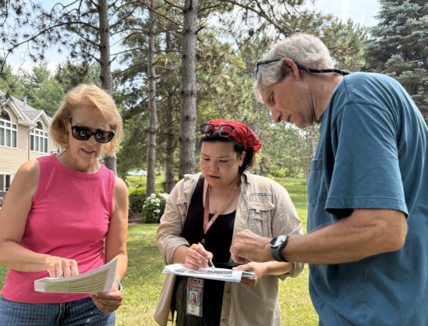
Milos working with Minnesotans to manage their personal forest lands.
Milos is passionate about her role and the efforts of the DNR’s Forestry team.
"Little by little, we're helping improve forest health conditions and increasing climate change resiliency across the state,” she says.
Milos also recognizes the significance of the space she occupies as an Asian American woman in a profession that has historically been held by white men. During her first three years as a forester, she never met another Asian American in the field. Today, she says she can still count the number she's met on one hand.
"Representation matters because it helps people see what's possible," she says. "If a young person can see themselves in this profession because they saw someone who looked like them, that's incredibly important. It's also important because the communities we serve are diverse. We need foresters with different backgrounds, experiences and perspectives to truly serve all Minnesotans."
Looking back, Milos sees a journey that began with a little girl searching for her place. Along the way, she realized belonging isn't always something you discover. Sometimes, it's a space you grow for yourself. Today, she's helping others do the same while shaping healthier forests, stronger communities and a profession that better reflects the people it serves.