By Misi Stine, Environmental Educator and member of the MN Herpetological Society
In the December 2024 newsletter article titled Here Kitty, Kitty: Wild Cats of Minnesota (Part 1), we explored the three species of wild cats in Minnesota, focusing on cougars (Puma concolor). Cougars are the second-largest wild cat in North America (after the jaguar) and have the widest historical distribution of any terrestrial mammal in the Western Hemisphere.
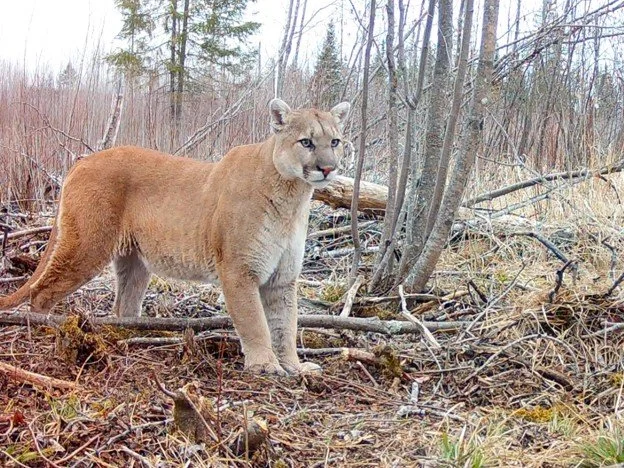
Adult Cougar, Photo credit: Voyageurs Wolf Project
As a reminder, Puma concolor goes by many common names, including mountain lion, puma, panther, catamount, and painter, to name just a few. The word puma derives from the Quechua language (Inca) of Peru, meaning "mighty, magic, or powerful animal." The word cougar comes from cuguacuarana (or susuarana) in the Amazonian Tupi language of Brazil, which translates to "false deer"—a nod to how perfectly the cat's tawny coat matches the color of its primary prey. Many other Indigenous cultures also have distinct names in their own languages that reflect their unique cultural relationship with this creature across its historic home range.
I am returning to the topic of cougars because of some exciting, groundbreaking developments recently reported by the Voyageurs Wolf Project in northern Minnesota.
A Brief History of Cougars in Minnesota
Cougars were native to Minnesota and occurred across the region prior to European settlement. However, they were less abundant than to the south and west of the state, likely due to a lower density of white-tailed deer—their primary food source. By the late 19th century, cougars were virtually eliminated from the state, with the last recorded historical specimens harvested in the late 1800s.
Since then, Minnesota has not been considered home to a resident cougar population—defined as one with established territories and active reproduction. Verified sightings remain rare, though they have been increasing. This rise is partly due to the widespread use of trail cameras, which capture images of transient cats passing through while avoiding human contact. Other evidence of dispersing individuals includes DNA analyzed from hair and scat samples, as well as vehicle collisions and other mortalities.
Most dispersers seen in Minnesota are young males traveling from the Black Hills, where a resident breeding population exists. Genetic evidence also shows that some cougars disperse here from Nebraska. Young males typically leave their mothers at around 10 to 18 months of age. Unlike females, males travel great distances from their natal range to establish new territories and seek mates—a behavior that helps limit inbreeding and reduces conflicts with established resident males.
In contrast, young females usually disperse only short distances from their mother’s territory, often occupying adjacent or overlapping ranges. This behavior, known as female philopatry, provides safety by allowing young females to remain in familiar habitats with reliable food resources.
The Major Discovery at Voyageurs Wolf Project
Between 2023 and 2026, researchers with the Voyageurs Wolf Project (VWP) in northern Minnesota reported eight sightings of individual cougars on study area trail cameras. These observations supported the scientific consensus that these animals were lone, dispersing young males from the Black Hills.
Then, in March of this year, researchers received a mortality signal from a GPS-collared white-tailed deer being monitored as part of a winter survival study. When they investigated the scene, they found the carcass cached and buried under leaf litter—a trademark sign of feline predation.
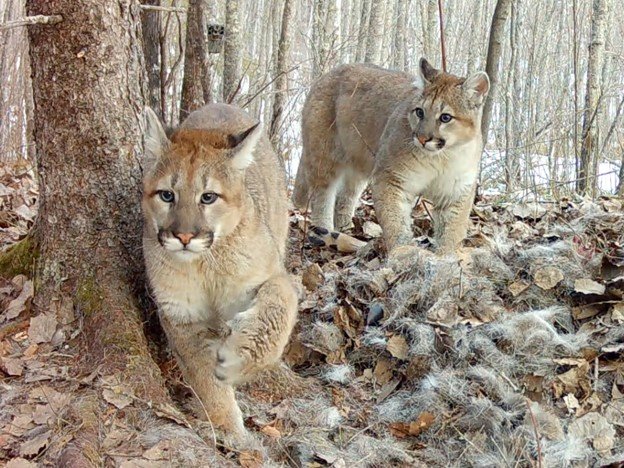
Cougar kittens, Photo credit: Voyageurs Wolf Project
Knowing that wild felines often return to feed, researchers set up trail cameras at the site. Within four hours, the cats returned. They were surprised to see it was a female with three kittens! This was completely unexpected given traditional cougar dispersal behaviors.
The cameras recorded hours of detailed video showing the family interacting and feeding. Based on physical traits seen in the footage, experts estimated the kittens to be 7 to 9 months old. This provided the first confirmed evidence of wild cougar reproduction in Minnesota in more than a century.
DNA Revelations
Working alongside the Minnesota Department of Natural Resources, the VWP collected scat and hair samples from the kill site and nearby trails. Genetic analysis revealed fascinating insights:
The Female: Traced back to the Nebraska breeding population (meaning she traveled roughly 550 to 700 miles—an exceptional journey for a female).
The Father: The genetic analysis indicated that a male captured on study cameras—related to the Black Hills population—is likely the father.
The Kittens: Samples were successfully retrieved from two of the three kittens, both of which were determined to be males.
Biologists noted that if the third kitten is also male, it may limit the immediate potential for expanding a local breeding population, as females are the critical limiting factor in establishing resident territory.
Looking Ahead
I strongly encourage you to visit the social media pages for the Voyageurs Wolf Project to follow their incredible work. While this cougar discovery is easily one of their most thrilling updates to date, the project regularly shares their research, including videos and pictures.
For nature lovers, this discovery raises hope that cougars may eventually re-establish a permanent foothold in the state. These events raise compelling questions: Why did this female travel so far from Nebraska to breed? Is she an anomaly, or the start of a broader shift? Thanks to modern technology revealing the hidden lives of wildlife, we will be watching closely to see what happens next.
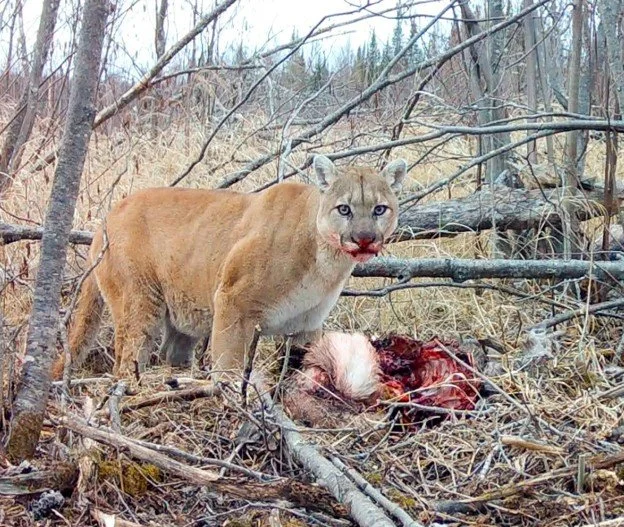
Cougar kittens, Photo credit: Voyageurs Wolf Project
Resources
Gable, T. D., Homkes, A. T., & Austin, S. (2026, April 30). First-ever footage of cougar mother and kittens in Minnesota [Video/News Release]. Voyageurs Wolf Project, University of Minnesota. https://www.voyageurswolfproject.org
Minnesota Department of Natural Resources. (n.d.). Cougars in Minnesota. State of Minnesota. Retrieved August 2026, from https://www.dnr.state.mn.us/mammals/cougar/index.html
Minnesota Department of Natural Resources. (2026, April 30). Evidence of reproducing cougar population documented in northern Minnesota [Press release]. State of Minnesota. https://www.dnr.state.mn.us/news/2026/04/30/evidence-reproducing-cougar-population-minnesota
Morrison, C. D., Boyce, M. S., Nielsen, S. E., & Stenhouse, G. B. (2015). Habitat selection and movement of a recolonizing cougar population in the Canadian Rocky Mountain foothills. PeerJ, 3, e1118. https://doi.org/10.7717/peerj.1118
Morrison, C. D., Boyce, M. S., & Nielsen, S. E. (2015). Space-use, movement and dispersal of sub-adult cougars in a geographically isolated population. PeerJ, 3, e1118. https://doi.org/10.7717/peerj.1118 Cited by: 45
Newby, J. R., Scott Mills, L., & Ruth, T. K. et al. (2013). Human-caused mortality influences spatial population dynamics: Pumas in landscapes with varying mortality risks. Biological Conservation, 159, 230–239. https://doi.org/10.1016/j.biocon.2012.10.018 Cited by: 70
O’Neil, S. T., Bump, J. K., & Beyer, D. E. (2014). Spatially explicit modeling of cougar dispersal corridor use and habitat suitability in the Great Lakes region. PLoS ONE, 9(7), e101108. https://doi.org/10.1371/journal.pone.0101108
Outdoor News Staff. (2026, July 23). Where did cougars in Minnesota's Voyageurs National Park come from? DNA sheds insight on their long journey. Outdoor News. https://www.outdoornews.com/2026/07/23/where-did-cougars-in-minnesotas-voyageurs-national-park-come-from-dna-sheds-insight-on-their-long-journey/
Shockman, L. (2026, April 30). Trail cameras capture footage of cougar kittens in northern Minnesota for first time in over a century. MPR News. https://www.mprnews.org/story/2026/04/30/cougars-in-minnesota-trail-cameras-capture-evidence-of-reproducing-population-in-state
Thompson, D. J., Jenks, J. A., & Fecske, D. M. (2014). Population dynamics of cougars in the Black Hills, South Dakota. The Prairie Naturalist, 46(2), 70–78.